Redesigning an Intro Astronomy Course for the GenAI Era
Elisabeth Newton, a professor of physics and astronomy, received a Teaching with GenAI grant to redesign her intro course. Newton made deliberate choices about where AI would be permitted in the course and where it wouldn't, and she gave clear guidelines. To encourage attendance and active participation, and to prevent cognitive offloading, she restructured some assignments to protect learning. Where she did permit AI, including in the creative final project, she set out explicit parameters for what acceptable use looked like.
Learning Goals
- Apply critical thinking and algebra to resolve astronomical problems and evaluate astronomical phenomena
- Engage in creative, collaborative projects integrating art with science
- Practice scientific communication and teamwork
- Develop intentional, informed habits around GenAI use
The Redesign
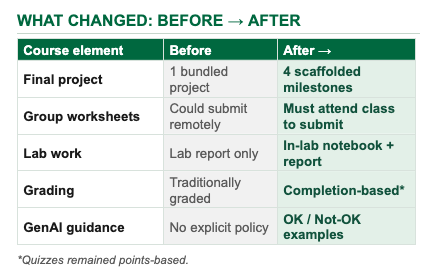
- Attendance-gated worksheets — students had to be present to submit group worksheets, restoring collaborative in-class discussions where students used to complete work individually and sometimes skip class
- In-lab worksheet — students submitted a “lab notebook” as part of their lab attendance and in-class work, separate from the final lab report
- Final lab reports with limited GenAI use — AI was permitted as a drafting tool, grounded in the students’ own notes
- Final project broken into four milestones — brainstorming, proposal, science connections, final product; process over product
- Completion-based grading for all class components except quizzes
- Full syllabus walkthrough on Day 1 to clear up persistent misconceptions about grading and GenAI use
What Worked
- Breaking the final project into milestones prevented last-minute omissions, e.g., skipped components due to rushing at the end
- Concrete OK/Not-OK GenAI examples communicated boundaries to students
- The attendance requirement for submitting worksheets reestablished in-person peer learning
- Completion-based grading kept the focus on participation and process
Challenges Encountered
- Attendance late in the term still dropped dramatically
- Students used GenAI heavily on lab reports, especially the solar lab (originally written for at-home completion)
- Splitting the in-lab worksheet and the lab report into two separate submissions increased TA grading workload
Changes for the Road Forward
- Physical, handwritten lab notebooks kept in the lab room — harder to outsource to GenAI, builds student ownership
- Introduce a pre-lab auto-graded Canvas quiz to reduce the TA grading burden
- Add lab questions to quizzes to reward deeper engagement during the lab
- State explicitly that GenAI is not appropriate for worksheets or in-lab notebooks
“Mostly, I was worried about students off-loading learning and thinking to GenAI. Which totally happened… but hopefully less than would have happened otherwise.
The goal was to force students to learn together, and to focus on process instead of product — because GenAI could do a decent job at some of the things students tended to do.”