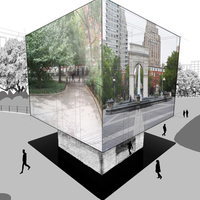
Architecture Fall Final Reviews: Art, Architecture & Public Space studio course
Students presenting their design projects for social space & public action, through the lens of art/architecture, for the Washington Square park in New York. With guest critics.
Public space has been vital to people and cities since ancient times as the designated space for dialogue, participation, collective activities, interaction and exchange, and essentially democracy. However, due to various social, political, and economic complexities, as well as technological advancements, public space has gradually transformed to less open, less democratic, less comfortable, less enjoyable, less “ours.” From one hand, codes, policies, and regulations reinforce limited use and accessibility, uncomfortable surfaces and furniture, and ubiquitous surveillance. From the other hand, the web culture has absorbed much of the dialogue and participatory practices that now occur more often in the digital realm. Public space is essentially not so “public” and not so “spatial.” Architects, urban designers, and planners often transform public space through proposals for plazas, parks, waterfronts, and monuments to offer spaces for aggregation and potentially to reenact social, cultural, and historical collective memories. Artists, intellectuals, as well as collective groups often critique the aforementioned top-down approach; they intervene in problematic situations through bottom-up initiatives and guerilla tactics, to instigate interaction, participation, and civic engagement.
The course received a travel grant by DCAL's Experiential Learning Initiative (ELI). https://thedartmouth.github.io/homecoming/#start_article
During this course the students have traveled to New York to experience and document through photographs, sketches, and on-site exercises a series of public spaces. The public spaces of the visit included: Washington Square Park, High Line Park, Times Square. Students have also visited the well-renown BIG (Bjarge Ingels Group) architects office in the Lower Manhattan, where senior designer Iannis Kandyliaris gave a tour, showed the projects, and discussed with the students the ideas and process of the architecture firm.
Washington Square Park is the site for which students design a series of projects that explore design as catalyst for social space and public action. Students are currently building models and partial full-scale prototypes to test their ideas and experience the conditions which they have envisioned. Students present their work to guest critics and experts to get feedback and advice on how to improve them.
The class occurs in parallel with the exhibition Speak!Listen!Act! by Zenovia Toloudi/ Studio Z, in Strauss Gallery, Hopkins, which serves as a think-tank laboratory for ideas for public space, and inter-exchange platform for topics for public space. Link to exhibition: http://studioart.dartmouth.edu/speak-listen-act-gallery-talk%20